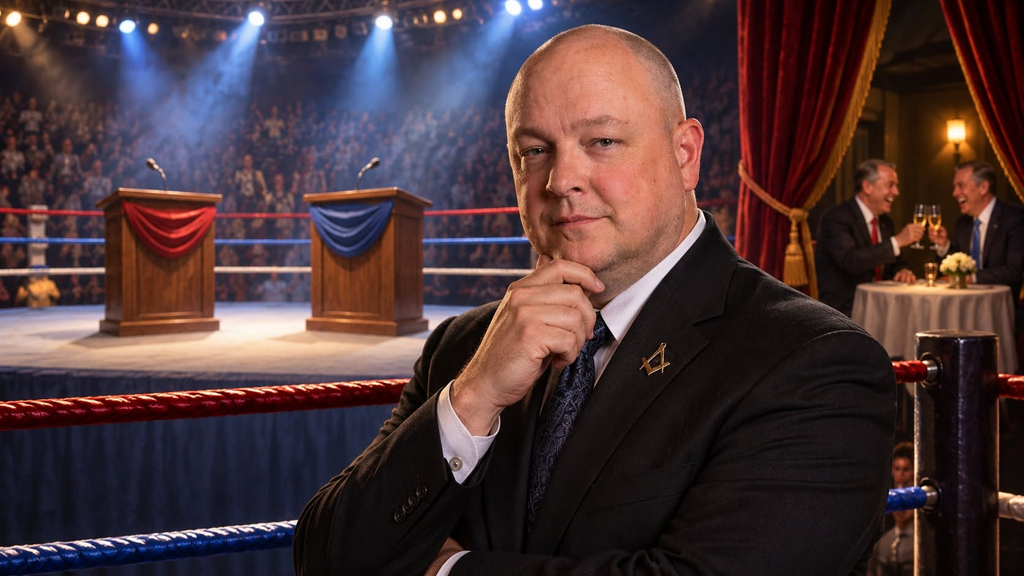
Tonight a few of my lodge brothers and I gathered for ritual practice. Attendance was light, so we did what Masons do when the room is small. We set the work aside for a while and talked. Those are often the best nights. The conversation is frank, honest, and offered on the level, and we try to work through the problems in front of us rather than just complain about them.
With election season in full swing, the talk turned to politics. That’s when our Worshipful Master said something I haven’t been able to stop thinking about.
He said modern politics is just 1990s WWF.
If you grew up in that era, you know exactly what he meant. Every Monday night, larger-than-life characters stormed the ring. There were heroes and villains, “faces” and “heels.” They cut fiery promos, swore eternal hatred for each other, and staged feuds that ran for months. The crowd screamed, picked sides, and bought the T-shirts.
Wrestling had a name for keeping up that illusion: kayfabe. The rule was simple. Never let the audience see that it’s a performance. In public, you hate your rival. Behind the curtain, you’re coworkers. You plan the next match together, work out who wins and how, and then maybe grab dinner and a few drinks on the way to the next town.
His point was that a lot of what we see on the political stage works the same way. The persona on the debate stage or in the attack ad isn’t always the real person. It’s a character built for a specific audience, with a script designed to fire up the base, raise money, and keep the job. Then the cameras turn off, and people from both sides of the aisle sit down together, talk about how the next show will go, and share a meal.
I’ve chewed on that all evening, and here’s where I’ve landed.
The dinner isn’t the scandal. Honestly, the fact that people who disagree can still break bread together is the most hopeful part of the picture. We do that in lodge every week. Men of different politics, faiths, and backgrounds meet on the level and part on the square. That’s not hypocrisy. That’s civilization.
The scandal is the show. The problem is when the hatred is staged for us. When outrage is manufactured because outrage gets votes and clicks. When we, the audience, are encouraged to despise our neighbors over a feud the performers themselves don’t really feel.
And here’s the hard part: we buy the tickets. Wrestling promoters gave the crowd what the crowd cheered for. Politics isn’t much different. If we reward the loudest promo, the cheapest shot, and the best villain, that’s what we’ll keep getting.
To be fair, not every person in public office is playing a character. There are men and women on both sides who mean what they say and serve with real conviction. Some of them pay a price for refusing to play along. They deserve our attention more than the performers do.
Freemasonry teaches us to judge a man by his conduct, not his costume. The square reminds us to test our actions. The level reminds us that we all stand on the same ground. The plumb reminds us to walk upright in every station, in public and in private. A man of integrity is the same person in the ring and behind the curtain.
So as you head to the polls, my challenge is this: look past the promo. Watch what candidates do, not just what they shout. Ask whether the person is the same in private as on the stage. And maybe most of all, don’t let anyone’s script turn you against the neighbor, coworker, or brother who votes differently than you.
The performers will have dinner together after the show. We should be able to do the same.